In 2026, open banking will become the foundation of online payments and one of the primary ways businesses receive funds. Open banking enables faster, smarter, and more secure transfers, improving customer focus and reducing business time. Major digital commerce platforms are already reflecting this shift, with marketplaces such as Amazon and eBay introducing Pay-by-Bank options in the UK, allowing shoppers to pay directly from their bank accounts.
At SSV SmartPay, we see these shifts already shaping both merchant behaviour and customer expectations. In this article, we explore the key trends driving modern payment solutions and accelerating the adoption of open banking.
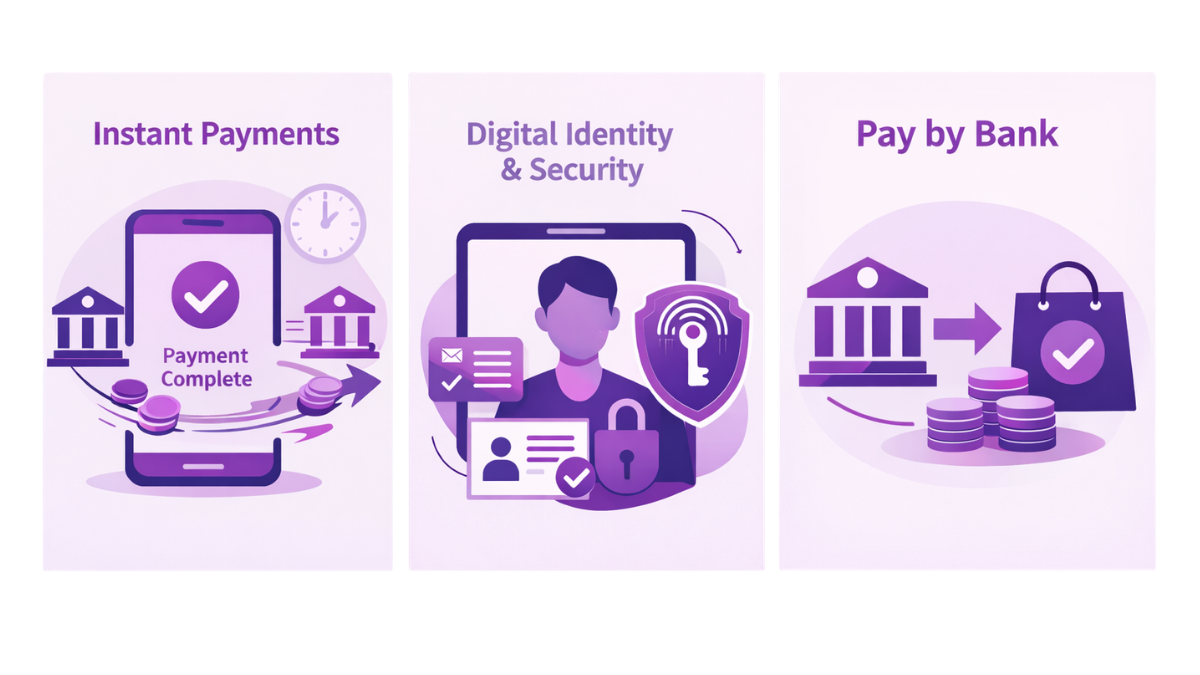
1) Instant payments are becoming the standard
Today’s pace of life demands more than convenience – it demands speed. Customers increasingly expect payments to be completed instantly, and businesses benefit directly from faster settlement and improved cash-flow predictability.
Open banking-based solutions, such as SSV SmartPay, are designed with this expectation in mind. Rather than adding complexity, they focus on delivering clear, real-time payment confirmation and faster access to funds. Supported by regulatory initiatives promoting instant payments, direct account-to-account (A2A) transfers are becoming a true alternative to traditional card payments.
The rapid commercial adoption of Pay-by-Bank checkout options by major digital marketplaces, including Amazon and eBay in the UK, signals that account-to-account payments are transitioning from an alternative method into a core payment infrastructure for ecommerce.
2) Digital identity and open banking are converging
Online verification is entering a new phase with the development of digital identity frameworks such as eIDAS 2.0 (the European Digital Identity Regulation (Regulation (EU) 2024/1183)). When digital identity is integrated with open banking, onboarding and payments become both simpler and more secure.
This convergence reduces friction during checkout, strengthens customer trust, and lowers the risk of abandoned transactions – a key priority for online merchants.

3) Pay by Bank is going mainstream.
Pay by Bank allows instant transfers of funds directly from the buyer’s account to the seller’s account, bypassing card transactions.
While it was considered a niche payment method, today it is increasingly becoming a mainstream solution.
According to statistics, in the German market alone, 75% of users who have tried Pay by Bank plan to use it again. This speaks to the growing trend toward simplicity, transparency, and efficiency.
The UK market is experiencing a significant acceleration in adoption as major commerce platforms (like Amazon, eBay) introduce Pay-by-Bank checkout experiences. When global marketplaces integrate this model at scale, consumer awareness grows rapidly, creating network effects that influence the wider merchant community.
This shift we are seeing in SSV SmartPay: more and more merchants are choosing Pay by Bank as their primary payment option, focusing on speed of settlement, reduced costs, and more predictable cash flow. SSV SmartPay enables businesses of all sizes to participate in this transition by providing seamless integration with existing payment workflows.
4) Instant refunds are gaining popularity.
What recently took weeks is now possible in seconds. Open banking allows for direct and virtually instant refunds, without lengthy bank delays. And as with instant payments, customers are beginning to expect it everywhere. This makes companies that have already implemented A2A payments automatically more loyal and customer-focused, and their operational processes more efficient and faster. As ecommerce leaders demonstrate the practicality of near-real-time refund processing, customers are beginning to expect similar service levels across all merchants.
Instant refund capability also improves customer satisfaction, reduces support overhead, and supports higher conversion confidence, especially in high-frequency digital commerce environments.
5) Open Finance
Open banking is evolving into Open Finance. With user consent, platforms can now access not only accounts and payments, but also savings, loans, and investment data. This broader data access enables more personalised financial products, smarter risk assessment, and services that better reflect real customer needs.
6) Moving Beyond Online
More and more industries are beginning to adopt open banking – including ecommerce, charities, travel, insurance, utilities, foreign exchange platforms, investment services, and even electric vehicle charging networks. All this is leading to open banking becoming a distinct infrastructure for the digital economy, rather than just another alternative payment method.
As open banking evolves from a trend into an infrastructure, the winning solutions are those that seamlessly integrate into existing business processes. SSV SmartPay’s approach is built around this idea: creating a payment infrastructure that runs in the background, without adding unnecessary steps for either businesses or customers, allowing companies of all sizes to access modern, high-performance payment capabilities without added complexity.
The future of finance is not about flashy features. It is about speed, transparency, and seamless integration into everyday business operations. As open banking becomes the foundation of the payments ecosystem, the focus is shifting to practical solutions that actually work for businesses. SSV SmartPay’s approach reflects this evolution, building a payments infrastructure that helps businesses grow without unnecessary complexity.
Resources:
Brite Payments – Open Banking Trends 2026
https://britepayments.com/resources/article/open-banking-trends-2026/
Open Banking Expo, Ellie Duncan – Feature: What’s in store for the UK and European ecosystem in 2026?
https://www.openbankingexpo.com/features/feature-whats-in-store-for-the-uk-and-european-ecosystem-in-2026/
Finextra, Open banking year eight: The foundation for agentic finance: https://www.finextra.com/the-long-read/1541/open-banking-year-eight-the-foundation-for-agentic-finance